The Ultimate Guide to Retractable Patio Awnings: Style and Function Combined
Introduction and Article Outline
Sun can turn a welcoming deck into a place nobody wants to linger, while sudden drizzle can interrupt an otherwise perfect evening meal. That is why shade solutions matter far beyond decoration: they shape comfort, protect furnishings, and expand how often a patio gets used. In this guide, we look closely at retractable patio awnings and other practical cover options so homeowners can compare features, costs, upkeep, and design choices with confidence.
At first glance, an awning may seem like a simple addition, but the right system can influence everything from afternoon temperature to the visual balance of a home’s exterior. A small townhouse terrace, a suburban patio, and a restaurant sidewalk each ask for something different. Some owners want a clean modern cassette that disappears when not in use. Others care most about wide shade coverage, easy motorized control, or fabric that can handle strong sun without fading too quickly. Good planning matters because size, projection, mounting height, and wind exposure all affect long-term satisfaction.
Before moving into the deeper comparisons, here is the outline of this article:
- How common awning types work and what sets them apart
- Why shade systems improve comfort, usability, and energy performance
- What to consider when choosing materials, style, and installation methods
- How to budget for purchase, maintenance, and long-term ownership
- Which features make the most sense for homeowners, families, and frequent entertainers
Among the many options available today, retractable patio awnings stand out because they offer flexibility. You can extend them when the sun is intense and pull them back when you want open sky, winter light, or protection during strong wind. That adaptability is one reason they remain popular in residential settings. At the same time, outdoor awnings as a wider category include fixed awnings, freestanding systems, window awnings, pergola-style covers, and commercial-grade units designed for larger footprints. Understanding this broader landscape helps buyers avoid a common mistake: choosing based on appearance alone rather than on climate, habits, and structure.
Think of the patio as an extra room with different rules. It has no drywall, but it still benefits from planning. It has no ceiling, yet overhead coverage changes the mood instantly. A well-chosen awning can make a summer lunch feel relaxed instead of rushed, reduce glare on screens or tabletops, and help cushions and rugs last longer. The sections ahead unpack those benefits in detail, so you can move from vague interest to a decision grounded in function, style, and realistic expectations.
Understanding Awning Types, Mechanisms, and Materials
To choose wisely, it helps to begin with the mechanics. Not all awnings work the same way, and the differences are not just technical footnotes. They affect convenience, cleaning, weather performance, and how polished the finished setup feels. The most familiar residential models are lateral-arm awnings, which extend outward from a wall using folding arms that hold the fabric under tension. This design is common for decks and patios because it creates a broad shaded area without vertical posts. In many homes, this is the format people mean when they talk about retractable patio awnings.
Operation can be manual or motorized. Manual models use a hand crank, which keeps costs lower and reduces the number of electrical components. Motorized models add convenience, especially for larger spans that would feel heavy or cumbersome to extend by hand. Some systems also integrate wind sensors or sun sensors. A wind sensor can trigger automatic retraction when gusts become risky, while a sun sensor can deploy the awning when sunlight reaches a set threshold. These features are useful, but they are not magic shields. An awning still has wind limits, and owners should understand that manufacturer ratings vary by size and model.
Beyond retractable systems, outdoor awnings include several other categories:
- Fixed awnings, which stay in place year-round and often suit windows or doors
- Freestanding awnings, useful where wall mounting is not practical
- Canopy-style covers, which may use tracks or more structured frames
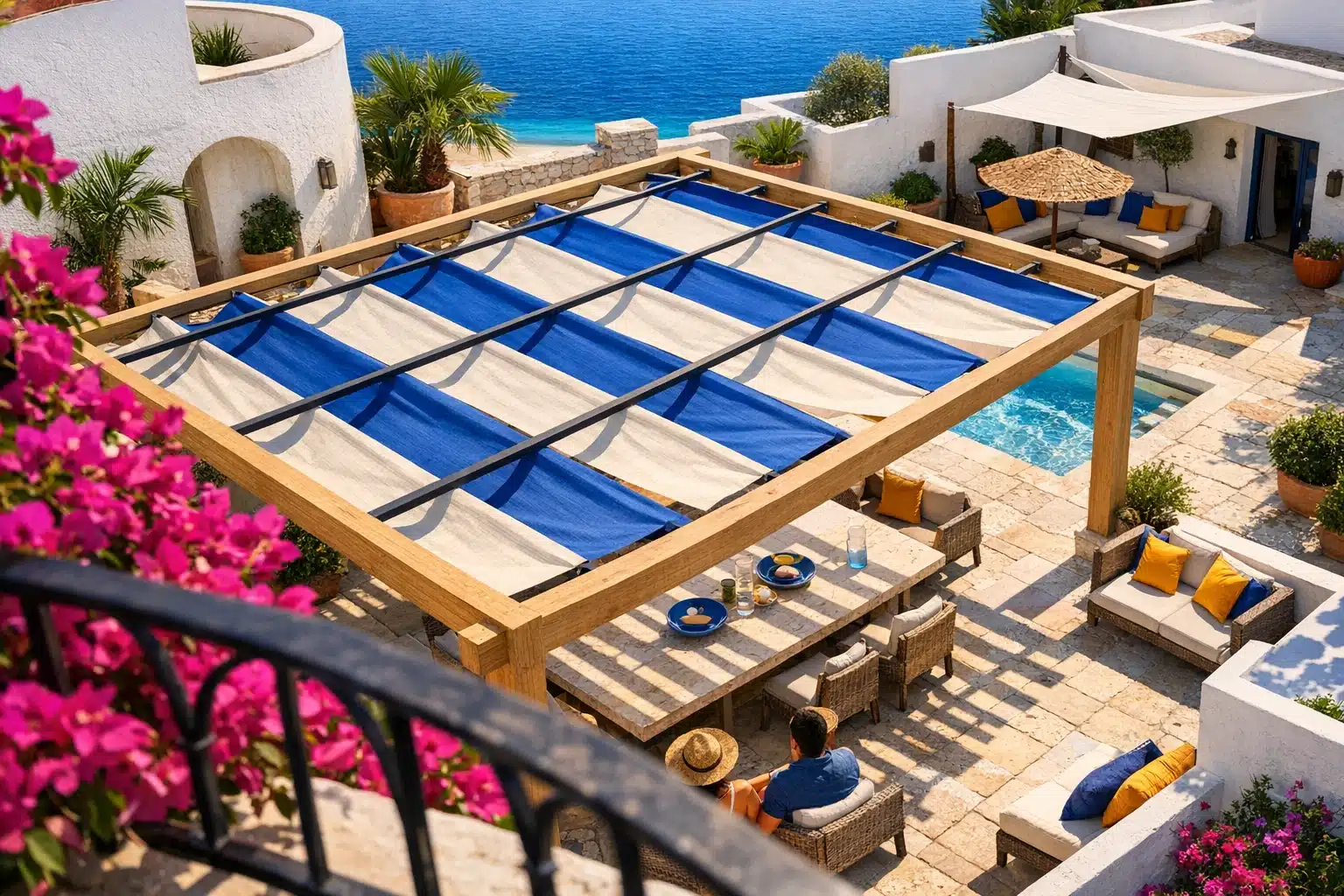
- Pergola awnings, which combine architectural support with retractable fabric panels
- Drop-arm or vertical awnings, better suited for low-angle sun and privacy needs
Material choice is equally important. Frames are commonly made from powder-coated aluminum because it is lightweight, corrosion resistant, and strong enough for outdoor use when engineered correctly. Steel may appear in some heavy-duty systems, though it needs careful finishing to resist rust. For fabrics, solution-dyed acrylic is often favored for its color retention and weather resistance. Polyester can be more affordable but may have different longevity depending on coating quality and sun exposure. Vinyl-laminated fabrics are sometimes chosen for higher water resistance, though they can feel less breathable and more utilitarian in appearance.
Cassette design also deserves attention. A full cassette encloses the roller, fabric, and arms when retracted, offering stronger protection from dirt and weather. A semi-cassette covers most key parts but leaves some components more exposed. Open-roll systems are simpler and often cheaper, but they leave fabric more vulnerable when not in use. In a sheltered setting, that may be acceptable. On an exposed wall, it may shorten the look-good phase of the installation.
The key lesson is simple: the best awning is not the one with the longest feature list. It is the one whose mechanism, fabric, and mounting system match the site. A compact balcony may need nothing more than a modest manual unit. A large west-facing patio used every evening might justify motorization, sensor controls, and a fabric chosen specifically for heavy UV exposure. Once you understand the parts, the shopping process becomes far less confusing.
Comfort, Protection, and Everyday Benefits
The most immediate reason people install awnings is comfort, and that benefit shows up in several ways at once. Shade lowers the intensity of direct sunlight, reduces glare, and makes outdoor seating more inviting during hours that would otherwise feel harsh. This may sound obvious, yet the practical effect is bigger than many buyers expect. A patio that sits empty for most of the afternoon can become a space for lunch, reading, remote work, or family gatherings simply because the sun is no longer beating down on every chair and tabletop.
Retractable patio awnings are especially useful in climates where conditions shift throughout the day. Morning may be cool and pleasant, noon may demand shade, and evening may feel best under open sky. That ability to adapt is one of their strongest advantages over permanent covers. Instead of committing to a fixed amount of darkness or enclosure, homeowners can respond to weather in real time. For people who enjoy gardening, grilling, or entertaining, that flexibility often turns the patio into a more dependable living area rather than a feature used only on ideal days.
Protection extends beyond human comfort. Outdoor furniture, rugs, cushions, and even some decking finishes age faster under continuous sun. While no awning eliminates wear entirely, reducing direct exposure can help preserve color and surface condition. Ultraviolet radiation is a major factor in fading, and quality awning fabrics are often designed to block a substantial portion of UV rays. In practice, this means less bleaching on textiles and a better chance that your outdoor setup still looks coordinated after a few seasons.
There can also be secondary indoor benefits. When outdoor awnings shade windows, glass doors, or walls that receive strong afternoon sun, nearby interior spaces may stay more comfortable. That can reduce the burden on cooling systems, especially in sun-facing rooms. The exact impact depends on orientation, insulation, window size, and climate, so it should not be treated as a guaranteed savings figure. Still, architects and energy-conscious homeowners often consider exterior shading a useful tool because stopping solar gain before it enters the building envelope is more effective than dealing with it after the room has already heated up.
Other everyday advantages are easy to overlook until you live with them:
- Meals are more pleasant without constant glare on plates, phones, or laptops
- Children and older adults may tolerate outdoor time better in cooler shade
- Light rain protection can keep an event going a little longer, depending on fabric and pitch
- The patio can feel visually complete, almost like a room with a soft movable ceiling
There is also an emotional benefit that numbers do not fully capture. Shade changes pace. A bright, exposed slab becomes a place where people actually settle in, talk longer, and stop squinting. The backyard starts behaving less like a passageway and more like a destination. That transformation is why so many homeowners begin with a practical goal and end up talking about atmosphere. The right awning does not simply block sun; it improves how the space is experienced from one ordinary day to the next.
Design Choices, Placement, and Installation Planning
Awnings work best when they are chosen as part of the architecture rather than as an afterthought. Color, projection, valance shape, cassette style, and mounting height all affect whether the final result feels integrated or improvised. The broad term outdoor awnings covers many visual styles, from crisp contemporary systems with hidden hardware to striped traditional designs that evoke cafés, seaside homes, or classic verandas. Neither approach is inherently better. The right choice depends on the lines, materials, and scale of the building itself.
Start with orientation. A south-facing or west-facing patio usually demands the most serious shade planning because the sun arrives with greater intensity during the hours many people want to be outside. Projection, which is how far the awning extends from the wall, matters just as much as width. A wide awning with shallow projection can still leave seating exposed at critical times of day. Mounting height also changes performance. Install too high without enough pitch, and the awning may fail to block low-angle sunlight effectively. Install too low, and circulation can feel cramped, especially near doors.
Fabric color deserves a practical lens, not just a decorative one. Lighter shades often feel airy and can reflect more heat, while darker tones may create stronger visual contrast and reduce glare under the canopy. Patterns can disguise small stains and add personality, but they should relate to the home’s exterior palette. Awnings tend to become a prominent visual element, so coordination with siding, brick, trim, decking, and outdoor furniture is worth the effort.
Installation quality is where good products either shine or disappoint. Retractable patio awnings rely on secure structural mounting, and that means attaching brackets to suitable framing or masonry rather than treating the exterior wall as a simple decorative surface. Improper fastening can lead to sagging, poor alignment, or dangerous failure under load. Professional installers typically review:
- Wall construction and structural backing
- Required mounting height and pitch
- Clearance above doors, windows, gutters, or light fixtures
- Electrical access for motorized systems
- Local wind exposure and the need for sensors or manual precautions
Homeowners should also think beyond the installation day. Will the awning interfere with shutters, cameras, lighting, or seasonal decorations? Does water run off cleanly? Is there enough open area for the unit to retract safely? In some neighborhoods, design rules or homeowner association guidelines may apply. In certain locations, larger installations can even trigger permit questions, especially if they alter façade appearance or attach to multifamily structures.
The best planning process balances aesthetics with real-world use. If your patio is used mostly for dining, prioritize coverage over the table and circulation zone. If it serves as a lounge, think about afternoon sightlines and whether the awning creates a pleasant sense of enclosure. When design and placement align with how people actually live, the finished result feels not only attractive but intuitive.
Costs, Maintenance, Buying Strategy, and a Practical Conclusion
Budget is often the point where enthusiasm meets reality, and that is not a bad thing. Awnings come in a wide price range because they differ in size, frame engineering, fabric quality, controls, and installation complexity. Smaller manual systems may be approachable for many households, while large motorized models with full cassettes, sensors, lighting, or custom finishes can move into a much higher bracket. Rather than asking for the cheapest option, it is wiser to ask what level of durability, convenience, and weather protection fits your habits. Spending more on features you never use is wasteful, but cutting corners on structure or installation can cost more later.
Maintenance expectations should be clear from the start. Outdoor products age better when owners treat them as equipment rather than as scenery. Most fabrics benefit from light cleaning with water and a manufacturer-approved cleaner, especially after pollen season, storms, or long dry spells that leave dust behind. Leaves and debris should not be allowed to sit in folds or cassette openings. Retractable patio awnings should be closed in high wind and typically left open to dry after light rain if the manufacturer permits wet exposure. That last detail matters because mildew concerns vary by fabric type and climate.
Here are practical buying questions worth asking before you commit:
- What wind rating applies to the exact size I am ordering?
- Is the fabric solution-dyed acrylic, polyester, vinyl-coated, or another material?
- What parts are protected in the cassette when retracted?
- How long are the frame, motor, and fabric warranties, and what do they exclude?
- Who handles service if the motor, arms, or controls need attention later?
- Can the awning be integrated with sensors, lighting, or smart controls if needed?
For many buyers, outdoor awnings are ultimately about reclaiming space they already own but do not use enough. A bare patio often looks larger on paper than it feels in midday heat. Add well-planned shade, and the same square footage becomes more usable for coffee, work calls, birthday dinners, or quiet evenings after the yard has gone still. The return is not only financial. It is measured in comfort, flexibility, and how often people choose to spend time outside.
If you are a homeowner comparing options, start by observing your space for a few days. Notice where the sun falls, when glare becomes irritating, and how wind moves across the patio. Measure carefully, think honestly about how often you will extend and retract the unit, and decide whether convenience features matter enough to justify extra cost. A simple system can be excellent when it suits the setting. A more advanced model can be worthwhile when the patio is a central part of daily life.
Conclusion for Homeowners and Outdoor Living Enthusiasts
The strongest awning choice is the one that matches your climate, your home’s structure, and the way you actually use your outdoor area. If you want adaptable shade with a clean profile, retractable patio awnings are often the most versatile solution. If your needs are more specialized, the wider world of outdoor awnings offers fixed, freestanding, and hybrid designs that may suit the site better. Choose with patience, install with care, and your patio can become one of the most enjoyable parts of the property instead of a sunny space you admire mainly from indoors.